What is UK SRS?
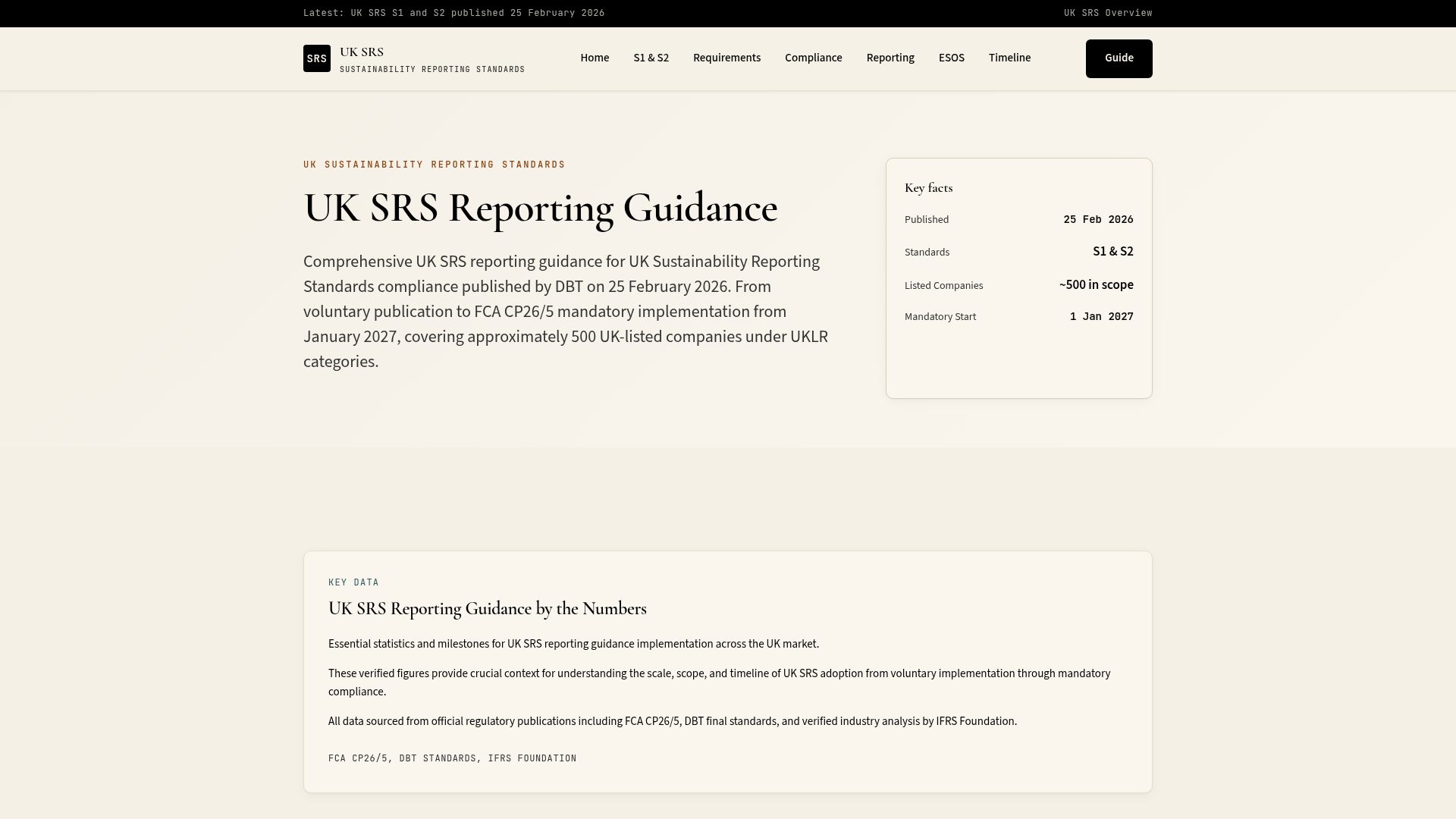
UK Sustainability Reporting Standards (UK SRS) are the UK's official framework for corporate sustainability disclosures, based on the global IFRS S1 and S2 standards but with specific UK adaptations. Published by the Department for Business and Trade (DBT) on 25 February 2026, UK SRS establishes mandatory reporting requirements for climate-related information (S2) and broader sustainability topics (S1) for UK-listed companies. The Financial Conduct Authority (FCA) proposes mandatory implementation from January 2027 for approximately 500 companies listed on the UK Main Market, replacing previous TCFD-aligned rules. The standards focus on investor-relevant information (single materiality) and are designed to enhance transparency, comparability, and accountability in corporate sustainability performance.
What is the Main Feature of UK SRS?
- UK-Specific Amendments
- Incorporates six key modifications to the baseline IFRS standards, including shifting SASB industry metrics from "shall" to "may" apply and providing one-year transitional relief for Scope 3 emissions reporting.
- Climate-First Phased Implementation
- Mandatory climate disclosures (S2) begin in January 2027, with general sustainability disclosures (S1) following on a comply-or-explain basis from January 2029. This staggered approach acknowledges implementation complexity.
- Precision in Scope
- Mandatory requirements initially target a defined group of approximately 500 UK-listed companies under UK Listing Rules categories 6, 16, and 22, ensuring focused regulatory impact rather than a blanket application.
- Flexibility for Financial Institutions
- Includes specific flexibility for financial institutions regarding financed emissions reporting, addressing sector-specific challenges.
- Voluntary Early Adoption
- Available for voluntary use by any UK company from February 2026, with an "all-or-nothing" rule requiring full standard compliance if adopted early.
How to Comply with UK SRS?
For in-scope UK-listed companies (~500 entities), compliance follows a structured timeline and process:
- Determine Scope
- Confirm if your company falls under UKLR categories 6 (Premium Listed), 16 (Standard Listed), or 22 (Debt Securities). Secondary listings (categories 14/15) follow home jurisdiction rules.
- Follow the Mandatory Timeline
- 1 January 2027: UK SRS S2 (climate disclosures) becomes mandatory. Scope 3 emissions are excluded for the first year.
- 1 January 2028: Scope 3 GHG emissions reporting moves to a comply-or-explain requirement.
- 1 January 2029: UK SRS S1 (general sustainability disclosures) applies on a comply-or-explain basis.
- Prepare a 12-18 Month Implementation Roadmap
- Key workstreams typically include Governance Setup, Data Infrastructure development, Scenario Analysis, and Disclosure Drafting, starting well before the 2027 deadline.
- Understand Assurance Requirements
- Initially, a "disclose-or-explain" approach applies—companies must state if they obtained third-party assurance or explain why not. Mandatory assurance is under separate government consultation.
- Utilize Official Resources
- Refer to the DBT final standards, FCA consultation (CP26/5), and the FRC's guidance for authoritative direction.
What is the Cost of UK SRS Compliance?
The "price" of UK SRS compliance is not a direct fee but the investment required for implementation. Costs vary significantly based on company size, sector, and existing sustainability reporting maturity. Key cost components include:
- Internal Resource Investment
- Dedicated team time for governance design, data collection, gap analysis, and report preparation.
- Technology & Data Infrastructure
- Potential costs for enhancing data systems to capture GHG emissions (especially Scope 3), sustainability metrics, and performance data.
- External Expertise
- Engaging consultants, legal advisors, or sustainability specialists for guidance on technical standards, scenario analysis, and disclosure drafting.
- Potential Assurance Fees
- If voluntary assurance is sought, costs for independent assurance provider services.
- Training & Capacity Building
- Educating board members, finance teams, and operational staff on new requirements.
The UK government's phased approach aims to manage market capacity and cost burdens by prioritizing climate disclosures first and providing transitional relief for complex areas like Scope 3.
Helpful Tips for UK SRS Implementation
- Start Early, Even If Voluntary
- Use the voluntary adoption period from February 2026 to conduct a gap analysis, identify data shortcomings, and build internal processes. Early adoption requires full compliance but offers a competitive edge.
- Focus on Governance First
- Establish clear board-level oversight and accountability for sustainability reporting. This is a foundational element of both S1 and S2.
- Parallel Track Data & Governance
- Do not treat data collection as a sequential step after governance. Develop data infrastructure alongside policy setting to accelerate readiness.
- Engage Suppliers Early for Scope 3
- The one-year relief for Scope 3 is limited. Begin engaging your value chain now to gather necessary emissions data.
- Monitor the MCR Programme
- If you are a large private company, watch for developments in the government's Modernising Corporate Reporting consultation, which may extend requirements to your sector.
- Don't Cherry-Pick Disclosures
- The UK SRS philosophy requires a comprehensive approach. Selective reporting undermines the framework's goal of comparable, complete information.
- Refer to the Transition Plan Taskforce (TPT) Guidance
- For climate transition planning, a core part of S2, the TPT framework provides valuable supplementary guidance.
Frequently Asked Questions about UK SRS
When does UK SRS become mandatory?
UK SRS S2 (climate disclosures) is proposed to be mandatory for financial years starting on or after 1 January 2027 for UK-listed companies in scope. The final rule will be confirmed in the FCA's Policy Statement expected in autumn 2026.
When is Scope 3 required under UK SRS?
Scope 3 GHG emissions receive a one-year transitional relief. While S2 becomes mandatory in January 2027, Scope 3 specifically moves to a comply-or-explain requirement from 1 January 2028.
Does UK SRS apply to AIM-listed companies?
No, the FCA's mandatory proposals in CP26/5 currently apply only to Main Market issuers (UKLR 6, 16, 22). AIM companies can adopt UK SRS voluntarily.
Do private companies have to report under UK SRS?
Large private companies are under review via the Modernising Corporate Reporting (MCR) programme; no mandatory requirements are confirmed yet. All private companies can adopt the standards voluntarily.
What are the six UK-specific amendments?
They include: (1) SASB metrics are "may" rather than "shall"; (2) One-year Scope 3 transitional relief; (3) Flexibility for financial institutions on financed emissions; (4) Climate-first phased implementation (S2 before S1); (5) Comply-or-explain for S1; (6) UK-specific effective dates.
How does UK SRS interact with existing SECR?
UK SRS and SECR (Streamlined Energy and Carbon Reporting) are complementary. SECR remains a mandatory Companies Act requirement for energy and Scope 1/2 reporting. UK SRS builds on this with more comprehensive climate risk, scenario analysis, transition plan, and full Scope 3 disclosures. SECR data can feed into UK SRS reporting.
Is assurance mandatory under UK SRS?
Not initially. Companies must disclose whether they obtained assurance or explain why not ("disclose-or-explain"). The government is separately consulting on potential future mandatory assurance requirements.
Can a company adopt UK SRS voluntarily before 2027?
Yes, any UK company can voluntarily adopt the full UK SRS standards from 25 February 2026. Early adoption requires applying the standards completely, not selectively.
UK SRS Guide
UK SRS implementation guidance covering standards, deadlines, and compliance requirements for UK Sustainability Reporting.
 Vercel
Free AI anime and manga generator. Turn text into anime episodes, manga, comics, webtoons and comic shorts in any art style — no drawing or animation skills needed.
Translate image text across 70+ languages with our advanced AI Image Translator to help you better expand your products globally to various countries
Advertised Here
Reach thousands of visitors daily. Get your spot now!
Tools similar to UK SRS Guide

Save 97% of your time by uploading receipts to Xero or QuickBooks from your phone. Instead of spending hours tracking receipts and expense reports, take a picture and text in just 5 seconds.
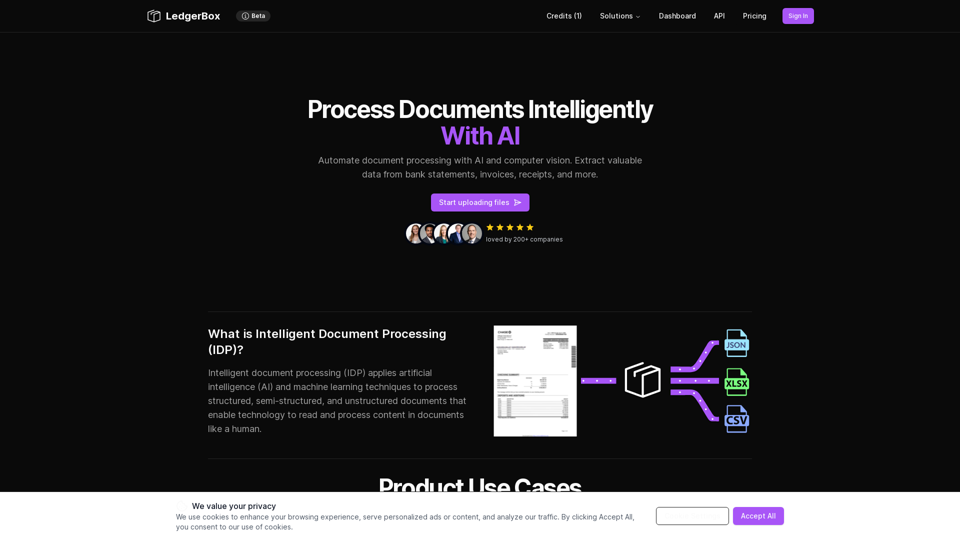
Automate document processing with AI and computer vision. Extract valuable data from bank statements, invoices, receipts, and more.