OurToken
Use one unified API to access OpenAI, Claude, GLM, MiniMax and other LLMs. Compare models, prices, and capabilities to find the best fit for your prompts.
What is OurToken.AI?
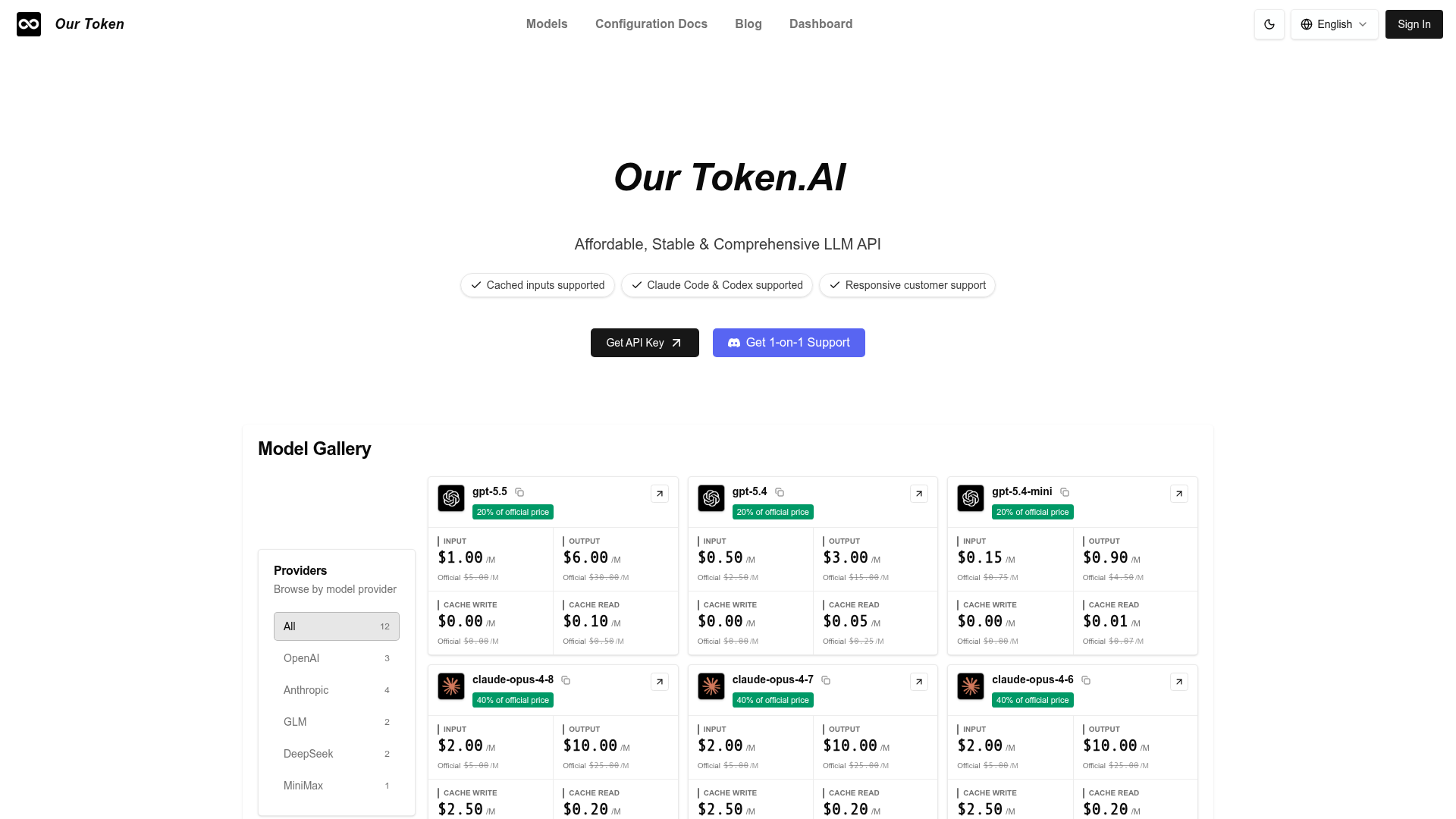
OurToken.AI is a unified LLM (Large Language Model) API platform that provides developers and businesses with affordable, stable, and comprehensive access to a wide range of leading AI models. It acts as a single gateway to top-tier providers like OpenAI, Anthropic (Claude), GLM, DeepSeek, and MiniMax. By aggregating these services, OurToken.AI simplifies integration, enables cost comparison, and offers significant savings—often 20% to 80% off official pricing—while supporting advanced features like cached inputs and Claude's Code & Codex models.
What are the main features of OurToken.AI?
OurToken.AI is built around core features designed to simplify and optimize AI integration for developers.
- Unified LLM API
- Access models from multiple leading providers (OpenAI, Claude, GLM, MiniMax, DeepSeek) through a single, consistent, OpenAI-compatible API endpoint. This eliminates the need to manage separate integrations and billing flows for each provider.
- Model & Price Comparison
- A centralized Model Gallery allows you to easily browse, filter, and compare the capabilities, context windows, and—critically—the pricing of different AI models side-by-side, helping you find the most cost-effective option for each task.
- Substantial Cost Savings
- The platform offers dramatically reduced pricing compared to official rates. For instance, access to advanced models like GPT-5.5 is offered at 20% of the official price, while Claude Opus models are available at 40% off, providing significant budget optimization.
- Advanced Technical Features
- It supports professional needs with features like cached inputs (reducing costs for repeated prompts), access to specialized models like Claude Code & Codex for programming, and reliable, stable API connections suitable for production applications.
- Developer-Centric Tools
- The platform includes transparent usage tracking, prompt routing capabilities to match tasks with the optimal model, and the flexibility to switch providers or models quickly without rebuilding your application stack.
- Responsive Support
- Users have access to dedicated customer support, including a direct link to 1-on-1 assistance via platforms like Discord, ensuring help is available when needed.
How to use OurToken.AI?
Getting started with OurToken.AI is a streamlined process designed for developers.
- Create an API Key: Start by signing up on the OurToken.AI platform and generating a unique API key from your user dashboard. This single key will manage your access across all supported model providers.
- Explore and Pick a Model: Navigate to the Model Gallery. Use the provider filters (e.g., All, OpenAI, Anthropic) to browse available models. Compare their specifications, context windows, and most importantly, the input/output pricing to select the best model for your specific workload, whether it's creative writing, code generation, or complex analysis.
- Call the Unified API: Integrate the OurToken.AI endpoint into your application. Use the provided OpenAI-compatible API shape to make requests. You simply specify your chosen model (e.g.,
gpt-5.5orclaude-opus-4-8) in your API call, and OurToken.AI seamlessly routes the request to the correct provider. - Track Usage and Optimize: Utilize the platform's dashboard to monitor your request history, token consumption, and costs in real-time. This data allows you to analyze spending patterns and optimize your usage, potentially by routing different types of prompts to different, more cost-effective models.
- Switch and Scale with Ease: As your needs evolve, you can effortlessly switch between providers or upgrade/downgrade models through the dashboard without any changes to your core application code, ensuring your AI capabilities can scale efficiently.
What is the price model for OurToken.AI?
OurToken.AI operates on a transparent, pay-as-you-go pricing model based on token usage (per million tokens for input and output), with no mandatory subscriptions. Its primary value proposition is offering access to premium AI models at a fraction of their official cost.
- Significant Discounts
- Prices are listed as a percentage of the official provider price. For example:
- OpenAI Models (GPT-5.5, GPT-5.4): Priced at approximately ### 20% of official rates.
- Anthropic Models (Claude Opus, Sonnet): Priced at approximately ### 40% of official rates.
- DeepSeek Models: Priced at approximately ### 80% of official rates.
- GLM & MiniMax Models: Offered at ### 60% and ### 40% of official prices, respectively.
- Clear Cost Structure
- Each model card explicitly shows the cost for Input tokens, Output tokens, Cache Write, and Cache Read operations, allowing for precise budgeting.
- Cost Optimization
- Features like ### Cached Inputs (where reading cached content is cheaper than processing new input) provide further avenues to reduce costs for repetitive or similar queries.
- No Hidden Fees
- You only pay for the tokens you use, with clear, upfront pricing displayed for every model in the gallery.
Helpful tips for using OurToken.AI
To maximize the value and performance you get from OurToken.AI, consider the following strategies:
- Leverage the Model Comparison
- Don't default to the most expensive model. Use the Model Gallery to compare. For example, for tasks that don't require top-tier reasoning, a model like
gpt-5.4-miniordeepseek-v4-flashmight offer the best balance of cost and capability. - Implement Prompt Routing
- Design your application logic to route different tasks to specialized models. Use a powerful model like
claude-opus-4-8for complex analysis and a lighter, cheaper model for simpler summarization or classification tasks. - Utilize Caching for Repetitive Content
- If your application sends similar prompts frequently (e.g., system instructions, template-based queries), enable and use the cache feature. Reading from cache is significantly cheaper than processing the same input tokens repeatedly.
- Monitor Your Dashboard Regularly
- Make it a habit to check your usage analytics. This will help you identify cost trends, spot any inefficient patterns, and validate that you are using the most suitable models for your workloads.
- Start with a Test Key
- When integrating, use a test API key and run benchmarks with different models for your specific use cases to gauge performance, accuracy, and cost before full-scale deployment.
- Engage with Support
- If you are unsure which model to choose for a particular task or encounter integration issues, take advantage of the responsive customer support available through the platform.
Frequently Asked Questions
What exactly is OurToken.AI?
OurToken.AI is a unified API gateway and platform that aggregates access to multiple large language model providers. It allows developers to integrate with one API to use models from OpenAI, Anthropic, GLM, DeepSeek, and others, often at heavily discounted rates, while simplifying billing and management.
Which AI model providers are supported on OurToken.AI?
The platform supports a growing list of leading providers, including ### OpenAI (GPT series), ### Anthropic (Claude Opus, Sonnet), ### GLM (from Zhipu AI), ### DeepSeek, ### MiniMax, and ### Google Gemini. New providers and models are added regularly to the Model Gallery.
Do I need to create separate accounts and integrations for each provider like OpenAI or Claude?
No, that's the core benefit. You only need one OurToken.AI account and one API key. The platform handles all the underlying provider integrations. You simply call OurToken's unified endpoint and specify the model you want to use.
Can I compare costs and performance between different models?
Yes, absolutely. The Model Gallery is designed for this. You can easily view and compare the pricing (input/output/cache), provider, and specifications of models like GPT-5.5 versus Claude Opus versus DeepSeek V4, all in one place.
Is the OurToken.AI API stable and reliable enough for my production application?
Yes. The platform is built with stability and scalability in mind, catering to developers running production workloads. It offers reliable connectivity and is designed to be a consistent integration point for multi-provider AI applications.
Can I switch to a different model or provider later if my needs change?
Yes, one of the key advantages is flexibility. You can switch the model parameter in your API calls at any time. If you find a better or cheaper model from another provider for a specific task, you can adopt it immediately without changing your core integration code.
OurToken
Use one unified API to access OpenAI, Claude, GLM, MiniMax and other LLMs. Compare models, prices, and capabilities to find the best fit for your prompts.
 Google Tag Manager
 Next.js
 Node.js
 React
React Vercel
 Webpack
Free AI anime and manga generator. Turn text into anime episodes, manga, comics, webtoons and comic shorts in any art style — no drawing or animation skills needed.
Translate image text across 70+ languages with our advanced AI Image Translator to help you better expand your products globally to various countries
Advertised Here
Reach thousands of visitors daily. Get your spot now!
Tools similar to OurToken
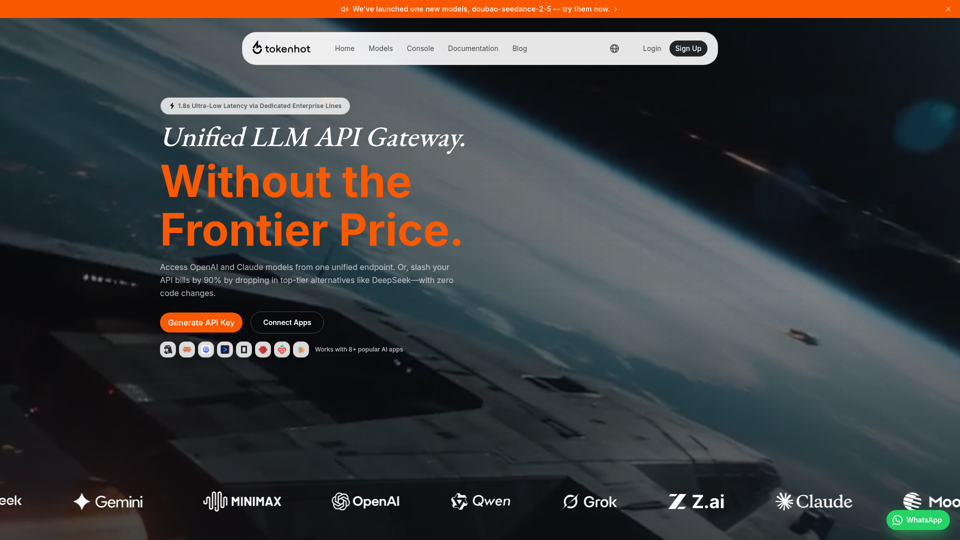
Better price, better stability. The unified LLM API gateway supporting OpenAI, Claude, Gemini, DeepSeek and 30+ providers.
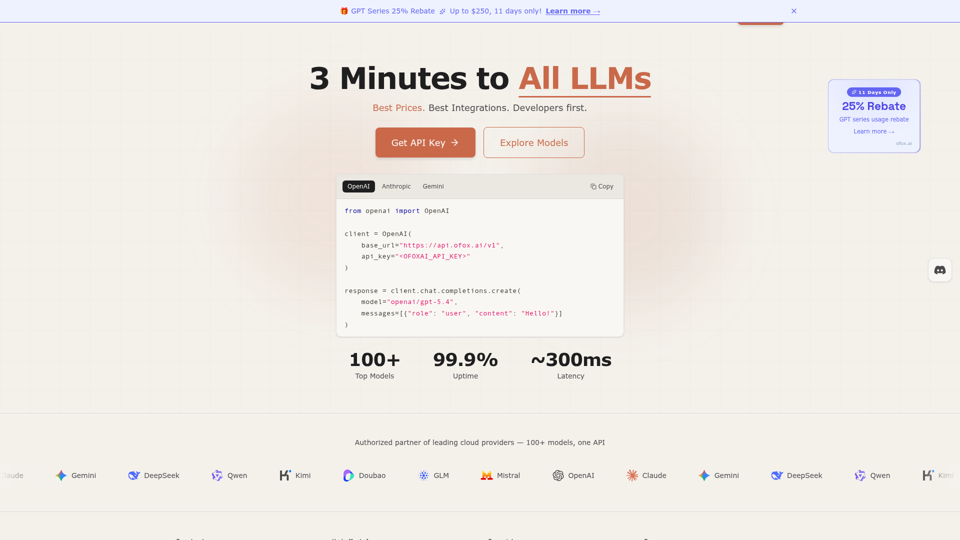
Unified LLM API gateway — access GPT-5.4, Claude Opus 4.6, Gemini 3.1, DeepSeek V3.2 and 100+ models through one API. OpenAI-compatible, 3-minute setup, pay-as-you-go. Low latency, 99.9% SLA. Built for developers who ship.
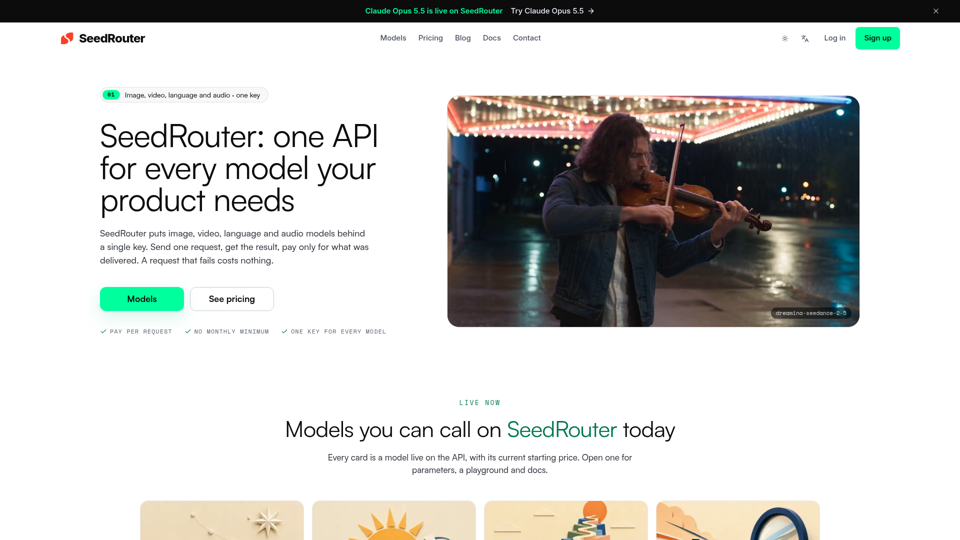
SeedRouter puts image, video, language and audio models behind one API key with pay-per-request billing. Failed requests cost nothing. Get your key.
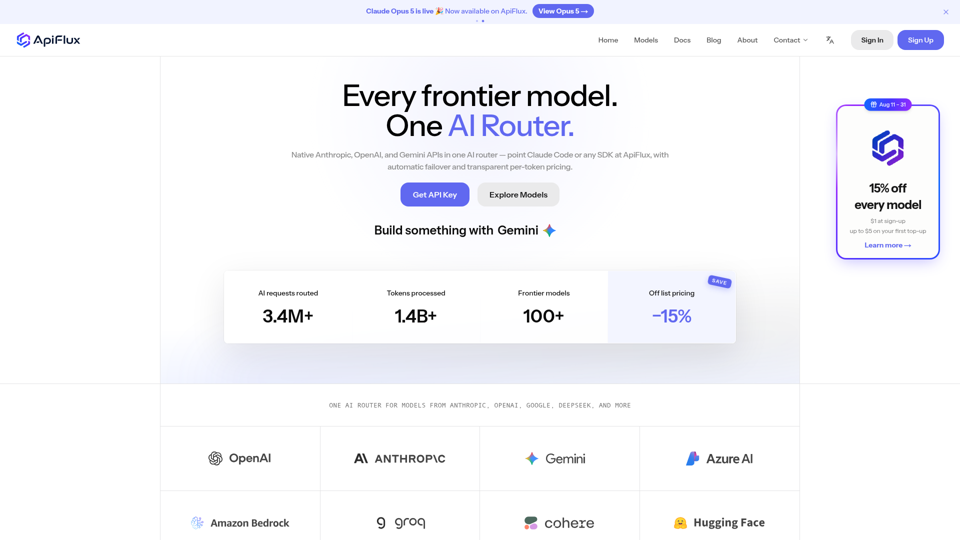
ApiFlux is an AI router with native Anthropic, OpenAI & Gemini APIs — one key for 100+ models, automatic failover, transparent per-token pricing. Claude Code ready.
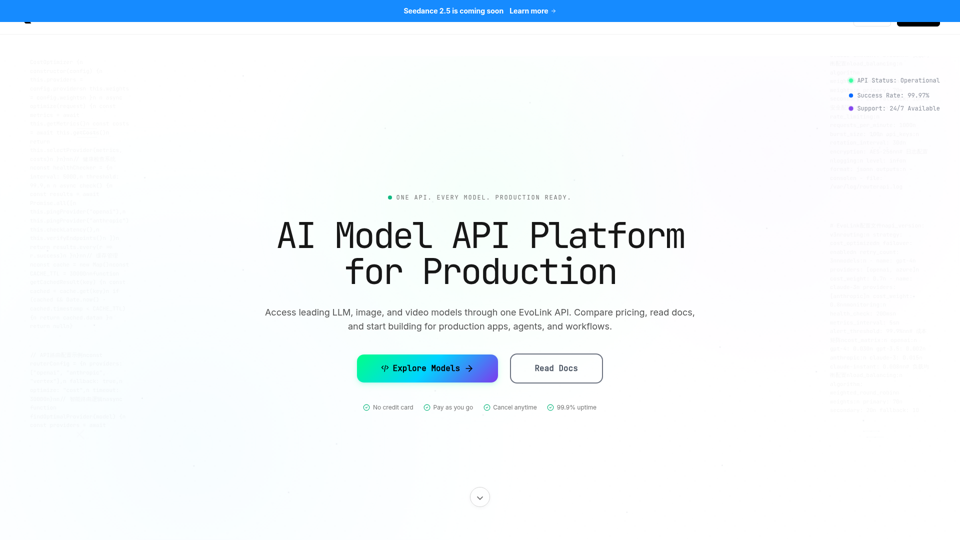
Access GPT, Claude, Gemini, Seedance, Kling & more via one EvoLink API. Get production-ready, cost-efficient access across LLM, image, and video models.
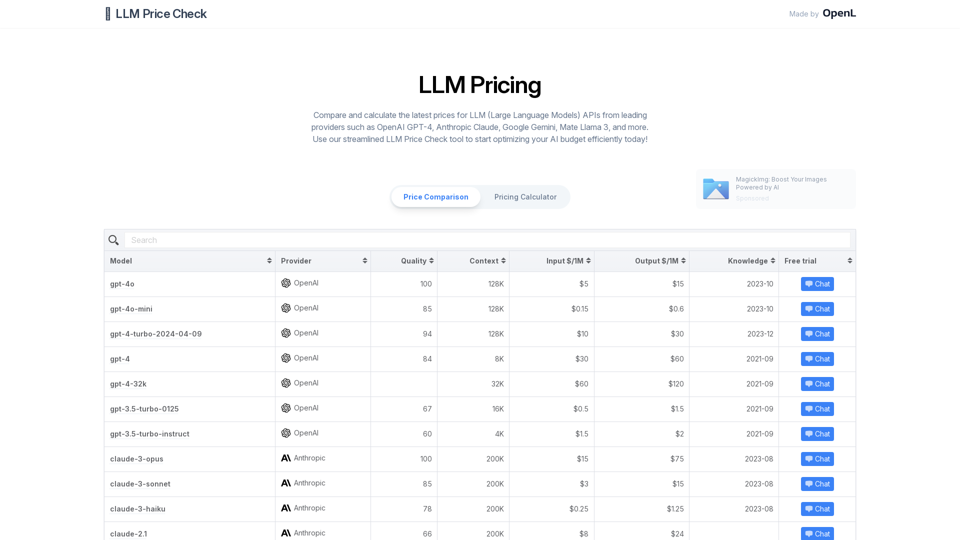
Explore cost-effective LLM API solutions with LLM Price Check. Instantly compare updated prices from major providers like OpenAI, AWS, and Google. Maximize your savings on LLM APIs starting today!
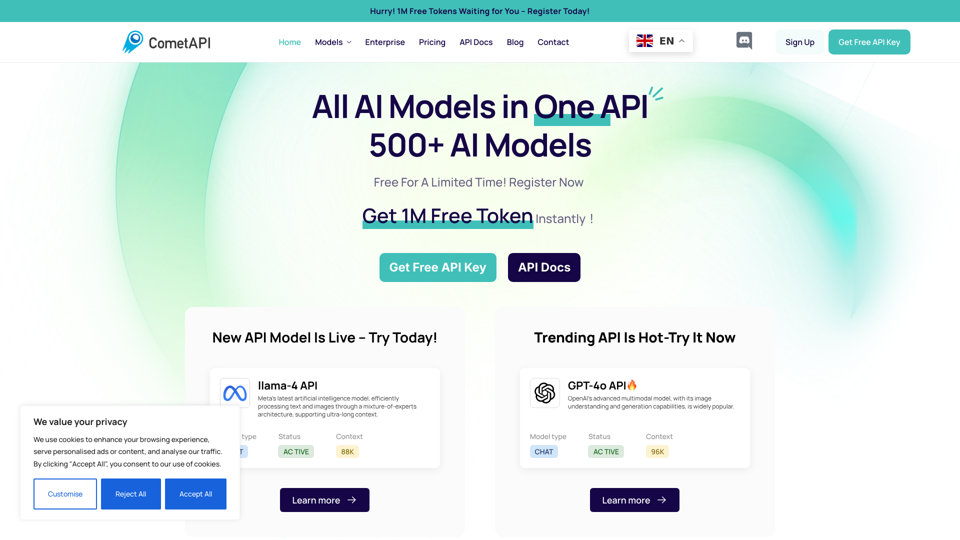
CometAPI simplifies AI integration, offering fast, reliable, and affordable API solutions to power innovative applications.
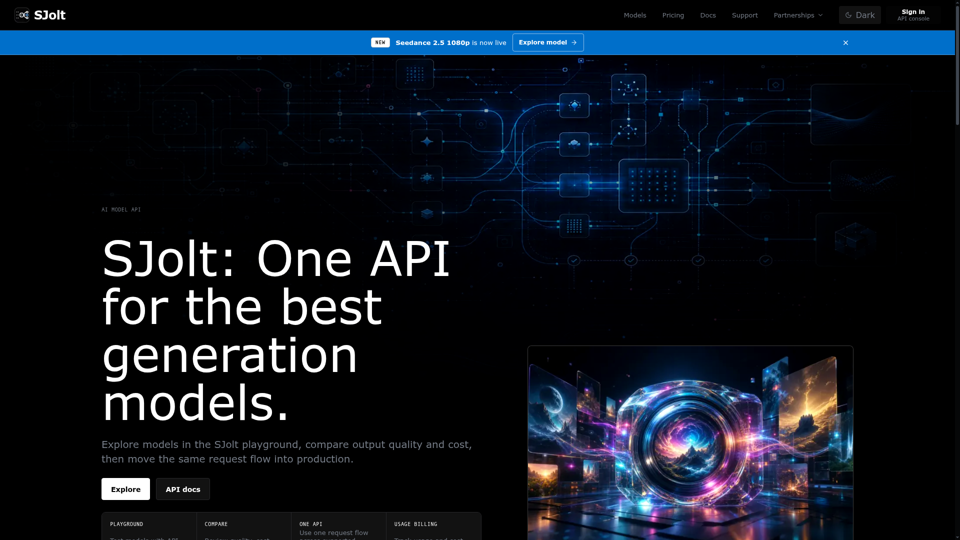
Explore image, video, and audio generation models in the SJolt playground, compare output quality and cost, then copy the same API request into production.