Framepack AI
Framepack AI revolutionizes video generation with advanced neural networks. Create high-quality, long-form videos with uncompromised quality using our cutting-edge AI technology.
What is Framepack AI?
Framepack AI is a groundbreaking neural network structure developed by researchers at Stanford University that revolutionizes how AI video generation models handle long-form content. At its core, it solves the fundamental ### "forgetting-drifting dilemma"—a major technical hurdle where models either forget earlier content or allow errors to accumulate and degrade quality over time. This innovative framework enables the generation of longer, more consistent, and higher-quality videos without a corresponding explosion in computational cost. By introducing a ### progressive frame compression technique that maintains a fixed transformer context length, Framepack AI makes long video generation not just possible, but practical and efficient. It stands as a significant advancement over traditional methods, opening new possibilities for content creation, from extended narratives to seamless image-to-video transformations.
Key Features of Framepack AI
- Fixed Context Length
- Maintains a constant computational bottleneck regardless of input video length. This is the core innovation that allows the model to process hundreds or thousands of frames as efficiently as it processes a few dozen, enabling long video generation.
- Progressive Compression
- Applies higher compression rates to less important historical frames, optimizing memory and compute usage while preserving the most critical visual and semantic information needed for consistency.
- Anti-Drifting Sampling
- Introduces novel sampling methods, such as generating both beginning and end frames first, to prevent the iterative degradation of quality (drifting) that plagues sequential frame generation.
- Compatible Architecture
- Designed to work with existing, pretrained video diffusion models (like HunyuanVideo and Wan) through fine-tuning, eliminating the need for costly and time-consuming retraining from scratch.
- Balanced Diffusion
- Supports more stable diffusion schedulers with less extreme flow shifts, which contributes to improved overall visual quality in the generated videos.
- Higher Training Efficiency
- Achieves training batch sizes (~64) comparable to image diffusion models, drastically accelerating the training process—a 13B parameter model can be trained in ~48 hours versus ~240 hours with traditional methods.
How Does Framepack AI Work?
Framepack AI tackles video generation through two interconnected, innovative mechanisms:
1. Progressive Frame Compression & Fixed Context
The system intelligently compresses the history of past frames. Instead of treating all previous frames equally, it uses a compression function that prioritizes recent and semantically important frames, applying stronger compression to older, less critical ones. Mathematically, this ensures the total context length fed into the transformer converges to a fixed upper bound, making computation invariant to the original video length. This directly solves the "forgetting" problem by ensuring key information is retained without overwhelming the model.
2. Anti-Drifting Sampling Methods
To combat "drifting" (error accumulation), Framepack AI moves beyond standard sequential generation:
- Anti-Drifting Sampling
- The model generates anchor frames (e.g., the start and end of a sequence) first, then fills in the gaps between them. This provides bidirectional context and prevents errors from propagating unchecked in one direction.
- Inverted Anti-Drifting Sampling
- Particularly effective for image-to-video tasks, this method generates frames in reverse order, using the high-quality input image as a stable reference point to guide the generation of preceding frames, ensuring consistency.
These methods work in tandem: compression manages memory and context, while anti-drifting sampling ensures the generation process itself is stable and high-fidelity.
Applications and Use Cases of Framepack AI
- Extended Narrative Video Generation
- Create coherent, multi-minute stories from text prompts without characters, objects, or settings morphing or disappearing over time.
- High-Quality Image-to-Video
- Transform a single photograph into a smooth, extended video sequence (e.g., a landscape coming to life, a portrait subject turning their head) while perfectly preserving the identity and details of the original image.
- Long-Form Content Production
- Efficiently generate educational explainers, product demos, or animated shorts that maintain visual quality and narrative consistency throughout their duration.
- Video Editing and Expansion
- Seamlessly extend existing video clips or fill in missing frames while maintaining temporal coherence and visual style.
Framepack AI Technical Performance & Resources
Performance Highlights: In comparative evaluations, Framepack AI consistently outperforms alternative architectures like Repeating I2V, Anchor Frames, and Causal Attention. Key metrics show superior ### Semantic Consistency and ### Clarity, along with significantly lower ### Drifting Error. The Inverted Anti-Drifting sampling method proved most effective, topping 5 out of 7 evaluated metrics.
Technical Resources:
- Research Paper
- The full academic publication detailing the methodology, mathematics, and experimental results is available for deep technical understanding.
- GitHub Repository
- The implementation code, configuration examples, and training scripts are open-sourced, allowing researchers and developers to experiment and build upon the work.
- Model Architecture
- The framework is flexible, with demonstrated variants (Base, Lite, Extended) and configurable parameters for compression (λ) and patchify kernels, allowing customization for different needs and hardware constraints.
Helpful Tips for Using Framepack AI
- Start with Fine-Tuning
- If you have an existing video diffusion model, integrate Framepack AI via fine-tuning rather than building from scratch to save significant time and computational resources.
- Leverage Inverted Sampling for Image-to-Video
- For the best results when animating a still image, utilize the Inverted Anti-Drifting sampling method to leverage the input image as a strong anchor.
- Optimize Batch Size for Training
- Take advantage of Framepack's efficiency by using larger batch sizes during training to dramatically speed up the process, similar to training image models.
- Experiment with Compression Parameters
- Adjust the compression parameter (λ) based on your specific needs. A higher value leads to more aggressive compression of older frames, which can be optimal for very long sequences where only recent context is critical.
- Mind the Hardware
- While efficient, generating high-resolution, long videos still requires substantial GPU memory. Ensure your setup meets the requirements (e.g., ~40GB for 480p generation) for smooth operation.
Framepack AI Frequently Asked Questions
What makes Framepack AI different from other video generation approaches?
Framepack AI uniquely solves the ### forgetting-drifting dilemma simultaneously. Unlike methods that tackle only one side of the problem, its ### progressive compression maintains a ### fixed context length, preventing forgetting, while its ### anti-drifting sampling stops error accumulation, preventing drifting—all without a computational penalty for longer videos.
Can I use Framepack AI with my current video generation model?
Yes. A key design goal of Framepack AI is compatibility. The research demonstrates it can be integrated with established pretrained models like HunyuanVideo through fine-tuning, meaning you can upgrade your pipeline's capabilities without a complete and costly architectural overhaul.
What are the hardware requirements for Framepack AI?
Framepack AI is highly efficient. Training a 13B parameter model at 480p resolution can be done on a single node with ### 8× A100-80GB GPUs. For inference, a single A100 or a pair of high-end consumer GPUs like ### 2× RTX 4090s can be sufficient, depending on the resolution and length of the target video.
How does Framepack AI handle videos of different resolutions and lengths?
The framework supports ### multi-resolution training with aspect ratio bucketing. Its core strength is that the computational cost is ### invariant to video length—generating a 60-second video requires a similar core computational footprint as generating a 5-second one, as the context length is fixed.
Is Framepack AI suitable for real-time video generation?
The primary focus is on high-quality, longer-form generation rather than ultra-low-latency real-time applications. However, its fixed-context-length architecture and efficiency are promising foundations that could be optimized for real-time or interactive use cases in the future, such as live streaming aids or interactive storytelling tools.
Framepack AI
Framepack AI revolutionizes video generation with advanced neural networks. Create high-quality, long-form videos with uncompromised quality using our cutting-edge AI technology.
 Cloudflare
 HTTP/3
Free AI anime and manga generator. Turn text into anime episodes, manga, comics, webtoons and comic shorts in any art style — no drawing or animation skills needed.
Translate image text across 70+ languages with our advanced AI Image Translator to help you better expand your products globally to various countries
Advertised Here
Reach thousands of visitors daily. Get your spot now!
Tools similar to Framepack AI
Explore the Veo 3 AI API by kie.ai, an advanced video generation tool that creates high-quality videos with synchronized audio and realistic scenes. Perfect for filmmakers, marketers, and content creators.

Everything you need to go from raw images or videos to production-ready model in one tool. No MLops skills or tricky integrations needed.
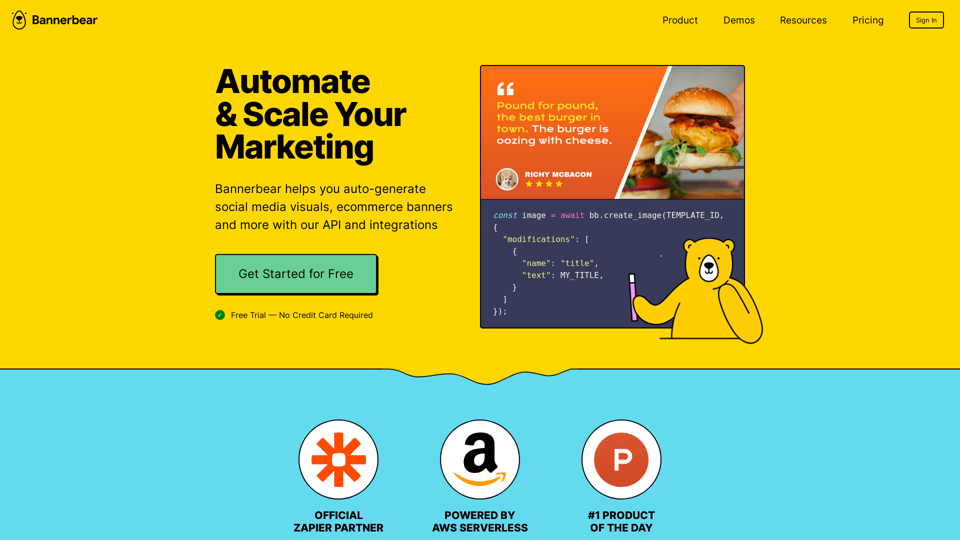
The Bannerbear API helps you and your team auto-generate social media visuals, ecommerce banners, podcast videos and more
Use Seedance 2.5 API with a practical guide for developers and agents: current access status, billing model, request builder, real code examples, and API key handoff.
SoraWebui is an open-source platform enabling users to easily create videos from text with OpenAI's Sora model.

Video, image, and GIF face swap API built for developers. Add face-swapping to your AI tool with minimal effort.